Prologue
Nighthaven did not begin as a place. It began as a condition.
The expansion was defined before it was imagined. It was scoped to exceed the physical footprint of Brimstone Sands by roughly fifteen percent, aimed squarely at late-game players who measure worlds by density and consequence. The schedule was shorter than any expansion before it, the team smaller, and the margin for error almost nonexistent. Leadership expectations were unambiguous. The zone needed to restore confidence in New World’s world design while remaining legible at scale, performant under strain, and compatible with the quiet, relentless demands of live operations.
These constraints were not accidental. They were the story’s opening tension.
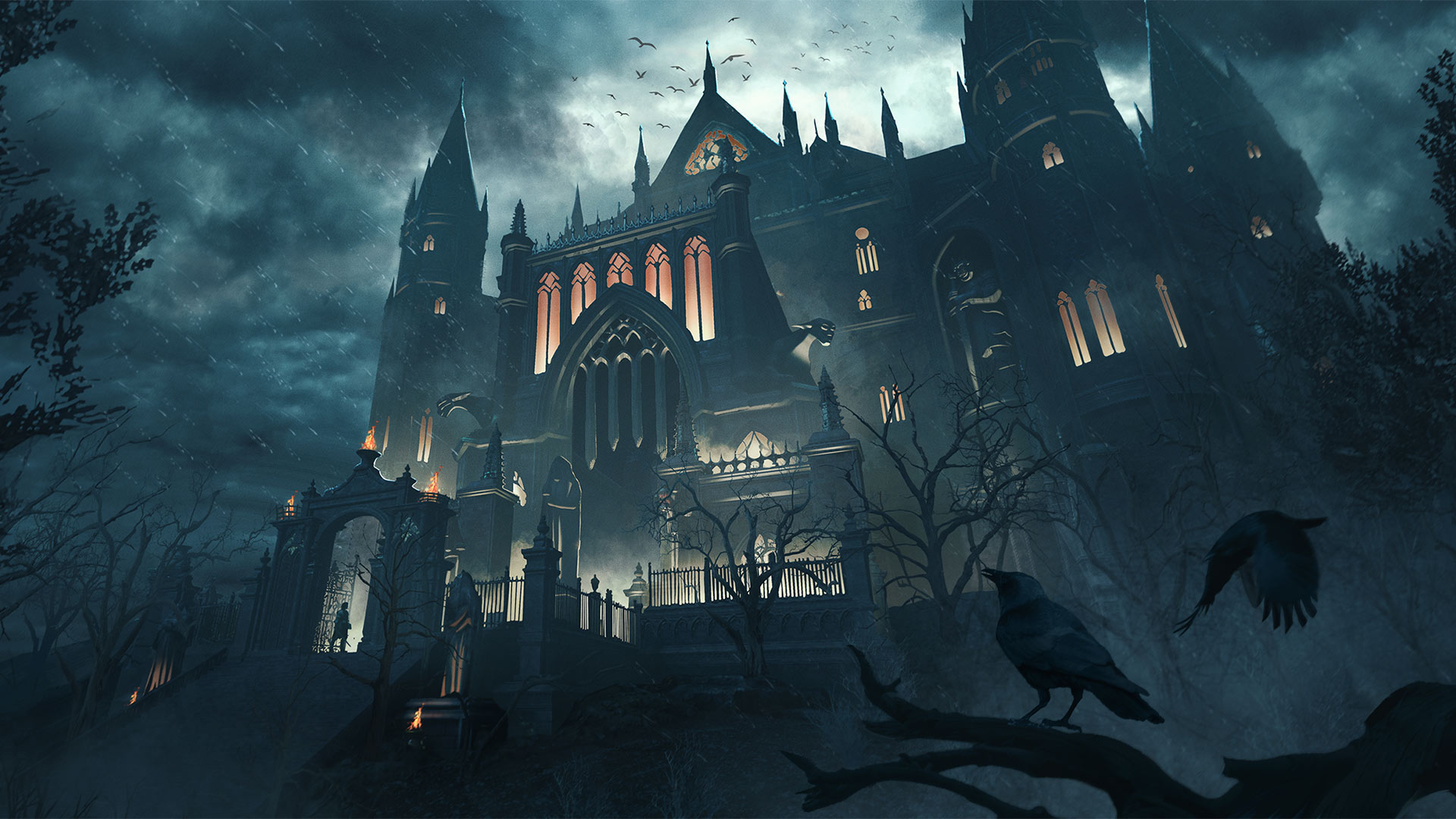
What followed was less an act of invention than of translation. Gothic horror and Eastern European folklore were not treated as costumes to be worn, but as a grammar through which fear, memory, and survival could be expressed. Political decay, haunted royalty, and subsistence economies formed the bedrock of a place shaped by what had been lost and what still refused to die.
This postmortem is the tale of how Nighthaven was authored under pressure, how structure substituted for excess, and how a world was made coherent not by abundance, but by restraint.
Act I: The Pillars
Nighthaven was greenlit in early 2024 as the capstone zone for Season 10. The design brief was narrowly defined: create a dark, atmospheric endgame destination that supported both solo and group play, integrated cleanly into existing endgame routines, and felt dangerous without becoming unreadable at scale.
The creative direction drew from gothic horror and Eastern European folklore: political collapse, haunted royalty, agrarian hinterlands, and mythologies shaped by fear and survival. The goal was not imitation, but internal coherence grounded in believable material logic.
Four zone pillars guided alignment across disciplines:
Danse Macabre — gothic horror, celebration of the dark, societal collapse, corrupt politics
Dreams & Nightmares — psychic instability, unreality, memory, trauma
Bounty of the Hinterland — farmlands, forests, wildlife, agrarianism
Dangerous Folklore — fairy tales, bedtime stories, monsters as cultural inheritance
These pillars were not rules. They functioned as shared heuristics. Designers referenced them when authoring landmarks, encounters, systems, and narrative hooks to ensure cohesion without micromanagement.
What remained unresolved at greenlight was how to execute this scope on an accelerated schedule while onboarding new designers unfamiliar with New World’s tooling, workflows, and live environment constraints.
I was promoted to Lead World Designer for this expansion. It was the second time I owned a zone end-to-end.
Act II: The Process
Research and Alignment
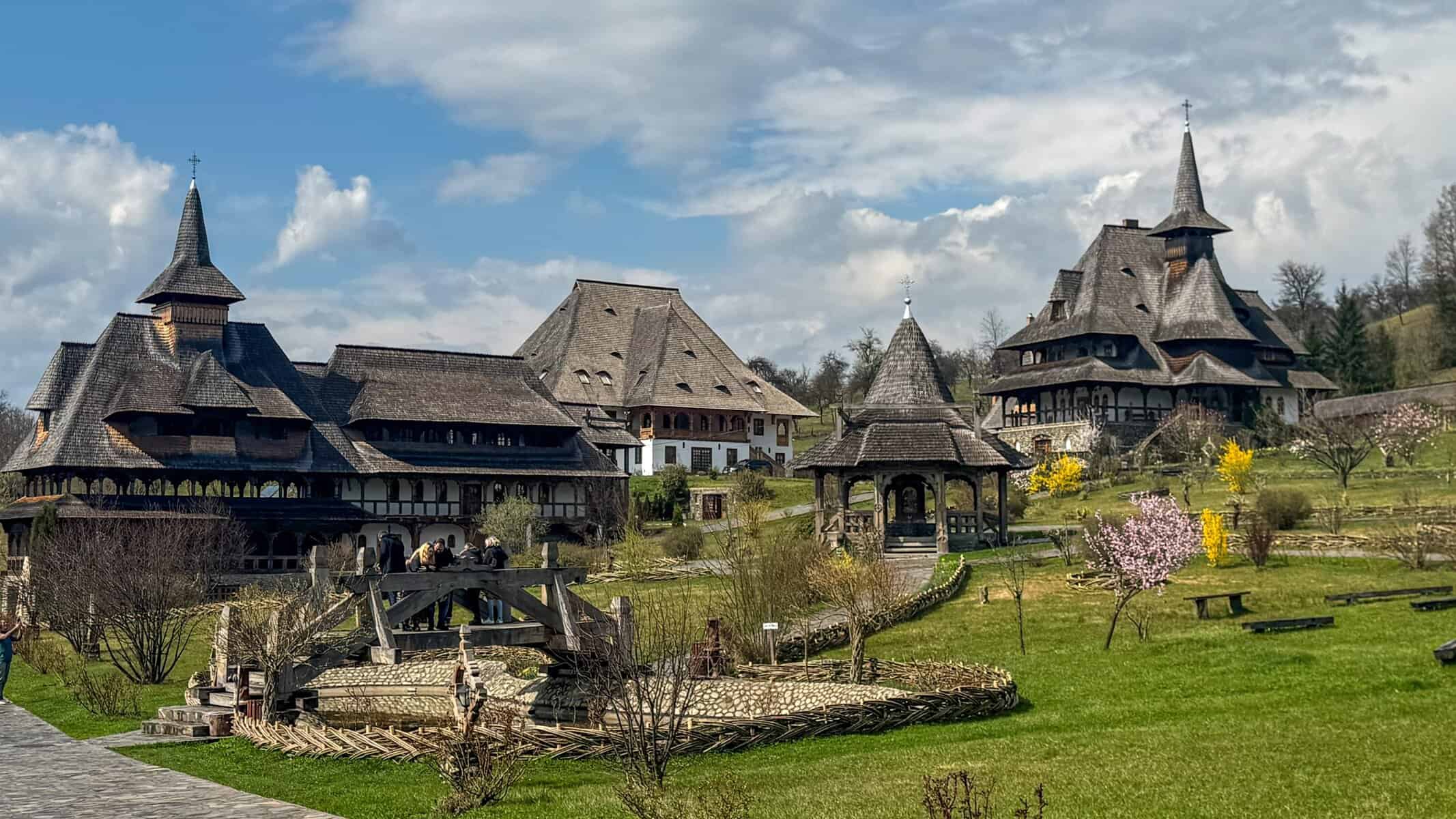
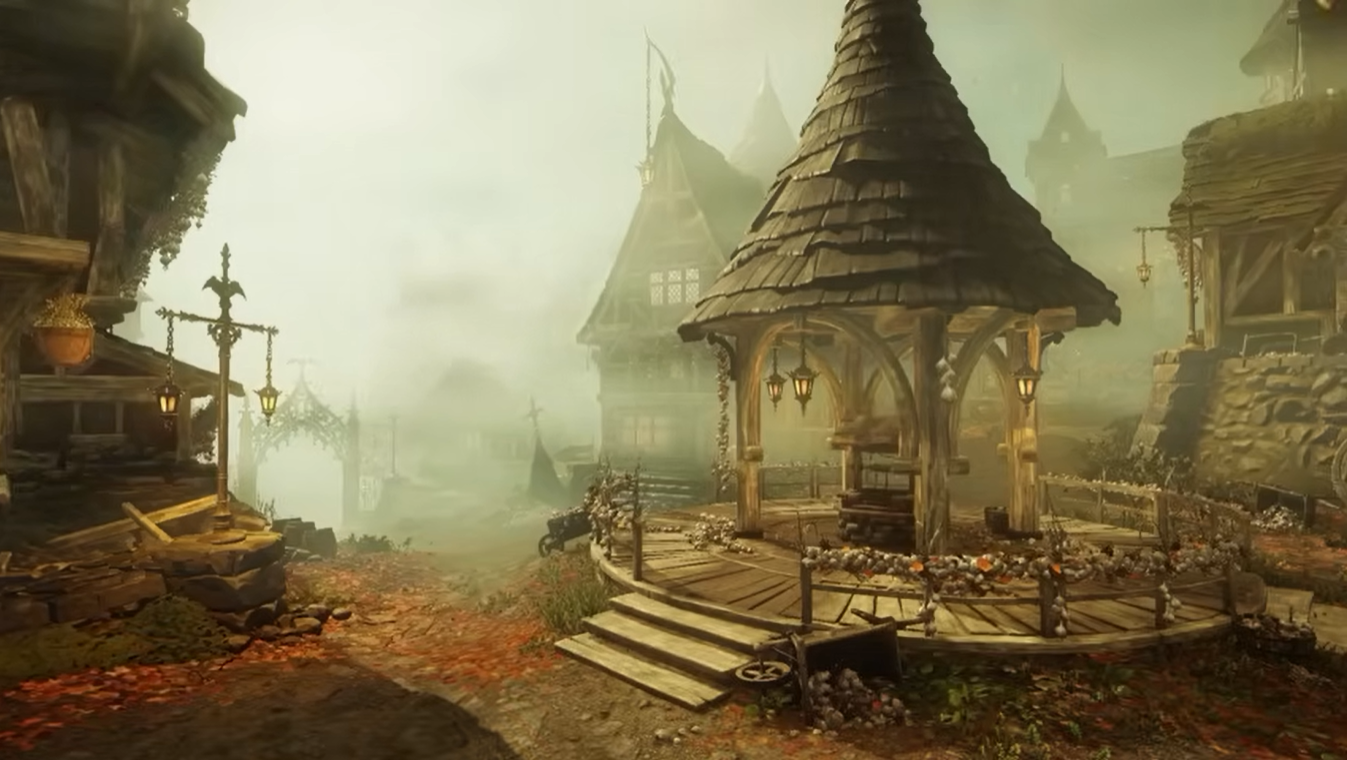
Early work focused on grounding the fiction and reducing ambiguity. Eastern European folklore is dense and regional, and superficial treatment risks collapsing into stereotype. Research emphasized architectural silhouettes, settlement logic, and material culture rather than iconography alone. Reference studies covered Transylvanian castles, Polish manor estates, Carpathian forests, Slavic monster taxonomies, and Dracula’s biography.
Alignment sessions established a clear definition of MVP. Given the schedule, large-scale exploratory experimentation was not viable. Features and interactables were evaluated against player value, systemic necessity, and production cost. Stretch goals were documented but explicitly gated until core pillars were complete.
The Zone Design Document became the central production artifact. It unified creative intent and execution rules in one place: tone, readability standards, encounter logic, economy allocation, enemy breakdowns, maps, asset requests, feature specifications, naming conventions, and authoring guidelines. The goal was to allow designers to work independently without constant synchronous review.
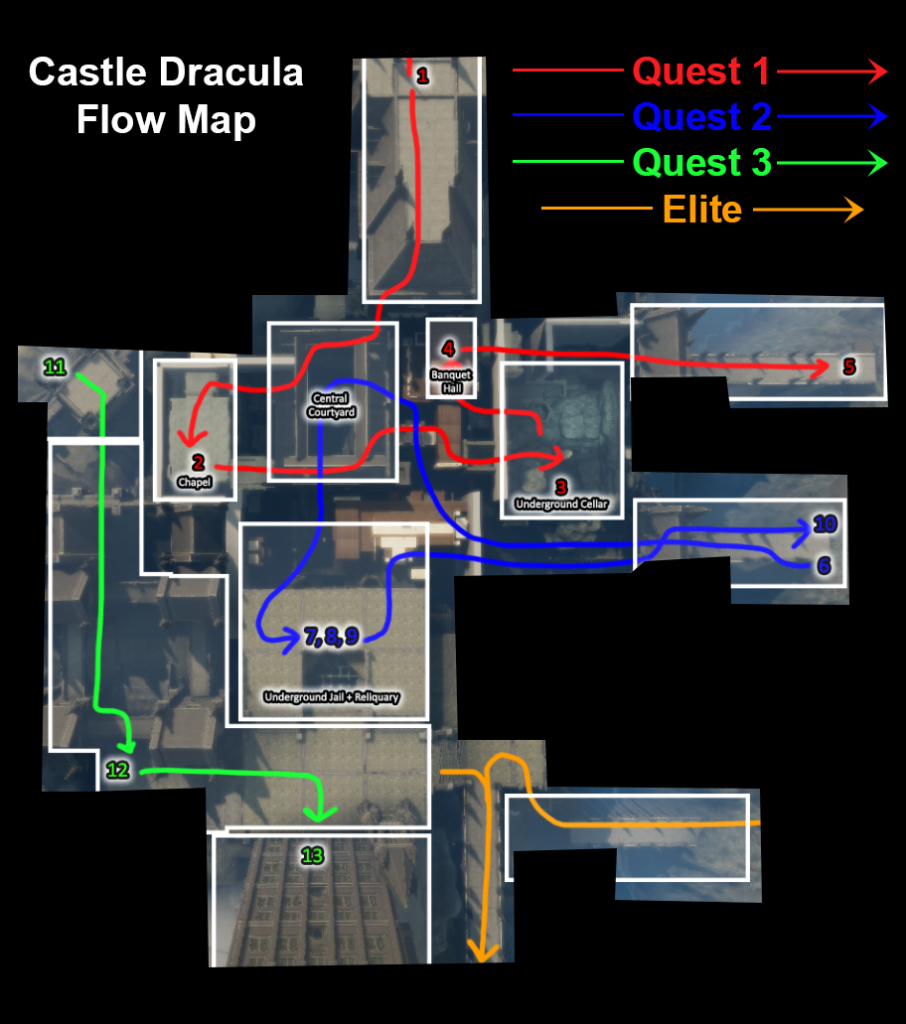
I mapped MSQ flow early and modeled anticipated player traffic to align narrative beats with exploration routing and server population distribution. This reduced late-stage rework caused by congestion or dead zones.
Prototyping and Scaling
Prototyping focused on traversal and encounter density. Nighthaven needed to feel oppressive without becoming disorienting. Forests used controlled sightline breaks. Vertical castles relied on strong landmark logic. Catacombs looped back to surface chokepoints to prevent navigation dead ends.
Systems were stubbed early, including elite sieges, traversal aids, and collectible interactions. These were not net-new experiments but evolutions of existing New World mechanics, validated at small scale before being multiplied across the zone. Testing exposed animation gaps, tooling friction, and performance constraints while changes were still inexpensive.
A playable slice validated end-to-end integration: navigation, combat rhythm, onboarding, and system clarity. It also stress-tested the pipeline itself—how quickly changes landed, where tools resisted iteration, and which content types carried the most risk.
Team Structure and Leadership
I led a team of six level designers responsible for over 90 unique Points of Interest. Weekly reviews and regular 1:1s reinforced scope discipline and pillar alignment. Most of the team had not shipped a New World zone before, so onboarding was treated as a design problem.
Documentation replaced tribal knowledge. POI templates, naming conventions, whitebox review gates, and interactable standards allowed designers to author content independently. As autonomy increased, I shifted focus toward high-risk integration work rather than local authoring.
POI Archetyping and Scale Management
To manage scale without sacrificing cohesion, Points of Interest were divided into explicit archetypes, each with defined layout rules, encounter expectations, and asset reuse strategies. This reduced cognitive load, limited combinatorial explosion, and allowed quality to scale predictably.
The primary archetypes were:
- Castles
- Ruins
- Graveyards
- Spider Caves
- Catacombs
- Villages and Farms
Each archetype relied on kit-based geometry or reusable layout patterns, tuned to support variation without re-authoring from scratch. Rather than treating every POI as bespoke, we treated them as authored instances within constrained design spaces.
A specific designer was assigned ownership of each archetype. That designer defined layout logic, traversal patterns, encounter pacing, and readability standards for their category, and reviewed downstream implementations for consistency. They were also responsible for a specific Creature family’s integration with the kit, including placement standards.
This model enabled parallel production while preserving a coherent player experience. Designers moved quickly within known constraints, environment art optimized asset production against stable requirements, and systemic tuning remained predictable across the zone. Archetyping also simplified playtest feedback: issues could be diagnosed at the category level rather than as isolated defects.
The result was a large, dense zone that felt intentionally structured rather than procedurally inflated.
Tooling improvements during production—WYSIWYG updates, streamlined source control branching, and improved debugging visibility—reduced iteration friction. These gains came with tradeoffs, including temporary workflow disruption and close coordination with engineering, but materially increased throughput once stabilized.
Collaboration was constant. Environment art defined biome composition and vistas. Creatures balanced enemy families and telegraphing. Quest fine-tuned MSQ routing and narrative chokepoints. Server tech modeled population behavior. Narrative authored 241 lore notes. Audio tuned ambience and encounter tells. Engineering implemented new interactables and resolved edge cases.
Work was organized around small strike teams with clear ownership and tight feedback loops. The model reduced coordination overhead and prevented hero-driven bottlenecks.
Feature Integration
Several open-world systems were integrated into Nighthaven:
Elite sieges evolved static POIs into dynamic combat spaces, allowing players to encounter large-scale battles organically along traversal routes.
Tarot Cards expanded on the Ancient Glyphs system introduced in Brimstone Sands. The collectible framework incentivized exploration while unlocking traversal aids and interactables. The system was designed in collaboration with quest, concept art, and engineering, emphasizing clarity and completionist motivation.


Unhallowed Flora and Fauna introduced nine new resource types tied directly to crafting and endgame optimization. These resources were integrated into existing economy loops rather than layered on top.
Memory Fragments were our first world exploration collectible which was tied directly to the Quest system, including peak rewards and long-term chase.
Each system required technical validation, UX clarity, and cross-discipline alignment. None were assumed to succeed until proven at scale.
Landmarks and Narrative Hooks
Castle Dracula became the largest interior landmark in the game. Its silhouette needed to read across the zone while remaining navigable internally. Iteration focused on vertical readability and looped traversal.


The Clocktower functioned as both landmark and systemic object. It conveyed server time through audio cues and acted as a navigation anchor. Its implementation required coordination across audio, engineering, narrative, and modeling.


Soul Trial: Lilith’s Dream was one of four solo boss encounters integrated into the zone. While Soul Trials were an established format, Nighthaven required tighter coupling to MSQ flow. Environmental disorientation was achieved through lighting and spatial tricks without sacrificing mechanical clarity.
I also authored The Chronicle of Nighthaven, a marketing vignette designed to establish tone prior to launch. Written as folklore, it framed fear as cultural memory and primed player expectations.
Iteration, Polish, and a Near-Failure
Playtests surfaced predictable issues: travel friction, solo difficulty spikes, and enemy readability gaps. These were addressed through traversal aids, aggro tuning, and improved silhouette differentiation. Lighting and VFX were refined to preserve clarity under low visibility.
One significant near-failure emerged late in production: a hard server population cap imposed due to infrastructure budget constraints. At launch, demand exceeded projections, resulting in extended login queues. While stability was maintained, the queues negatively impacted early sentiment.
Mitigation required rapid coordination with server tech and live ops to rebalance population distribution and queue handling. The issue did not undermine the zone’s design, but it reinforced the importance of aligning world scale with live infrastructure realities earlier in the process.
Final QA focused on stability, performance, localization accuracy, and content correctness. While minor issues were inevitable, no progression-blocking or systemic failures shipped.
Act III: The Outcome

Nighthaven launched in October 2025. Engagement and retention exceeded internal projections. Community sentiment shifted decisively, with players and creators citing the zone’s atmosphere, density, and encounter variety as a turning point for New World.
The expansion delivered a zone larger than Brimstone Sands on a compressed schedule by emphasizing reuse, disciplined scope control, and documentation-driven execution rather than asset novelty.
Two MMORPG.com GOTY awards followed: Most Improved MMO and MMO Expansion of the Year. These accolades reflected reception quality and execution consistency, not proof of correctness, but they validated the approach under public scrutiny.


What I Learned
Constraints enforce discipline. Limited resources forced prioritization. Features justified their cost or were cut.
Documentation scales teams. Clear rules enabled autonomy and reduced coordination overhead.
Evolution beats reinvention. Extending proven systems minimized risk while still delivering novelty.
Playtesting replaces assumption. Observed behavior consistently corrected internal intuition.
Polish determines legibility. The final integration pass defined how players read and trust the space.
Live infrastructure matters. World scale must be reconciled with server realities earlier than feels necessary.
Epilogue
Every tale ends where it began, with the goals that shaped it.
Nighthaven was built by a multidisciplinary team navigating severe constraints with the shared goal to make the best zone ever. The team carried that vision forward and gave it form.
What mattered most was not individual contribution, but a shareable vision that could be handed from one discipline to another without distortion, with rules that could be trusted when time ran out. A process that held even as pressure increased. It was not shaped by excess or spectacle, but by deliberate structure and a collective understanding.
The result was not an accident. It was a tale told carefully to endure.