The Ancient Glyphs were a systemic exploration feature I devised for Brimstone Sands in 2022.
Across New World, players had long encountered recurring Ancient greebles. These were ornamental markings embedded in ruins, artifacts, UI elements, and devices. These motifs were visually consistent but functionally inert. They existed as atmospheric details without mechanical meaning. While developing Brimstone Sands, I saw an opportunity to transform those passive symbols into an authored language that could drive exploration, lore, and gameplay systems simultaneously.
Inspired by constructs like the Daedric Alphabet from The Elder Scrolls, we formalized the markings into a complete symbolic set. The system ultimately comprised 26 Ancient Glyphs, each assigned a distinct meaning or conceptual domain. I collaborated closely with Carrie Berg, a designer with formal anthropological training, to develop these meanings. Together, we grounded the glyphs in patterns drawn from real world hieroglyphs, proto languages, and symbolic structures. This ensured they felt culturally coherent rather than arbitrarily fantasy.
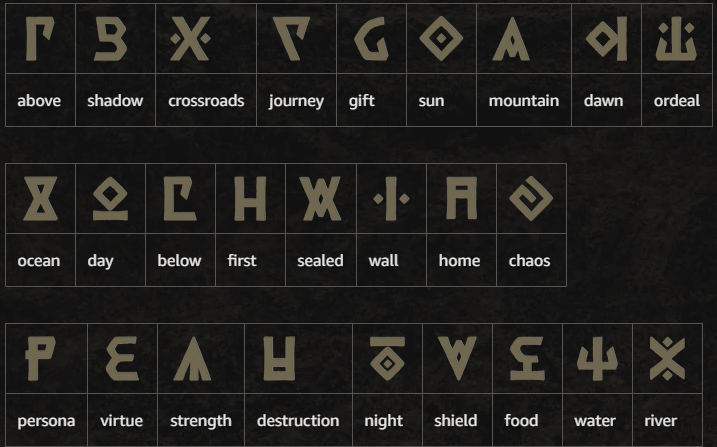
Each glyph was authored with intent. Some carried broad philosophical meaning, while others were designed to map directly to narrative beats, quests, or environmental mechanics within Brimstone Sands. The result was a symbolic language that functioned both as lore and as a gameplay key.
Technically, the glyphs leveraged Lore Page infrastructure to function as a collectible codex within the player’s Lore Journal. This allowed us to track individual player acquisition while enabling systems to query that data. On top of this foundation, I designed and implemented mechanics that directly depended on glyph ownership.
Ancient portals activated only when a specific glyph was known. Sealed chests required glyph knowledge to open. A hidden elite boss encounter only spawned once all 26 glyphs had been discovered.
I wanted the system to feel like a new layer of magic in the world, written magic that could change the environment around you as long as you know the translation of the word.
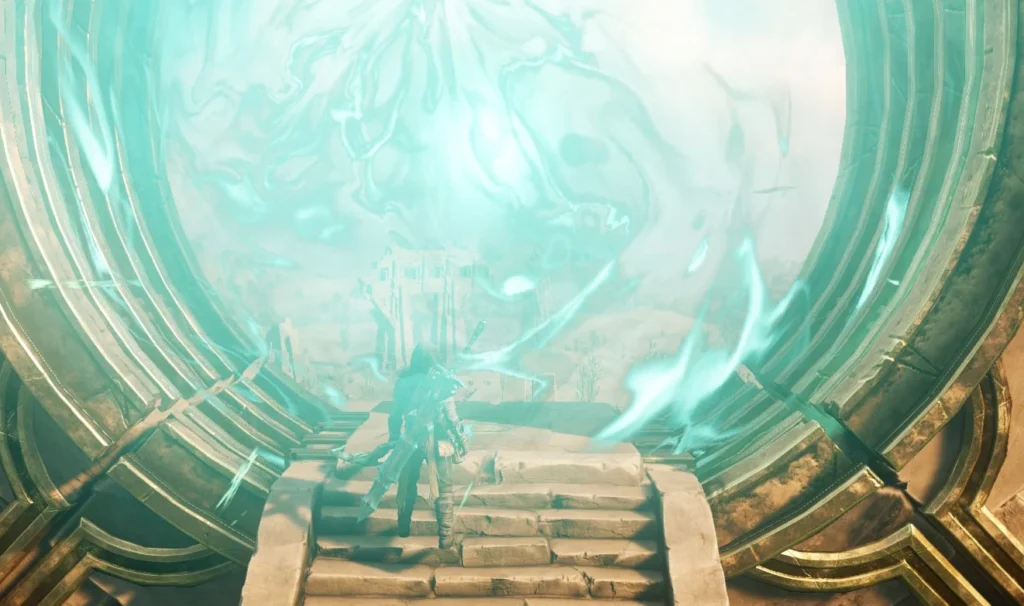
These interactions were implemented as public features. If one member of a group possessed the required glyph, the interaction benefitted all nearby players. This reinforced cooperative discovery and prevented progression deadlocks while still preserving the sense of earned knowledge.
The work was largely self directed. I drove the system end to end. This included concept, design, implementation, and integration. There was no dedicated oversight. This ensured the glyphs were not just collectible trivia but structurally embedded into Brimstone’s exploration loops.
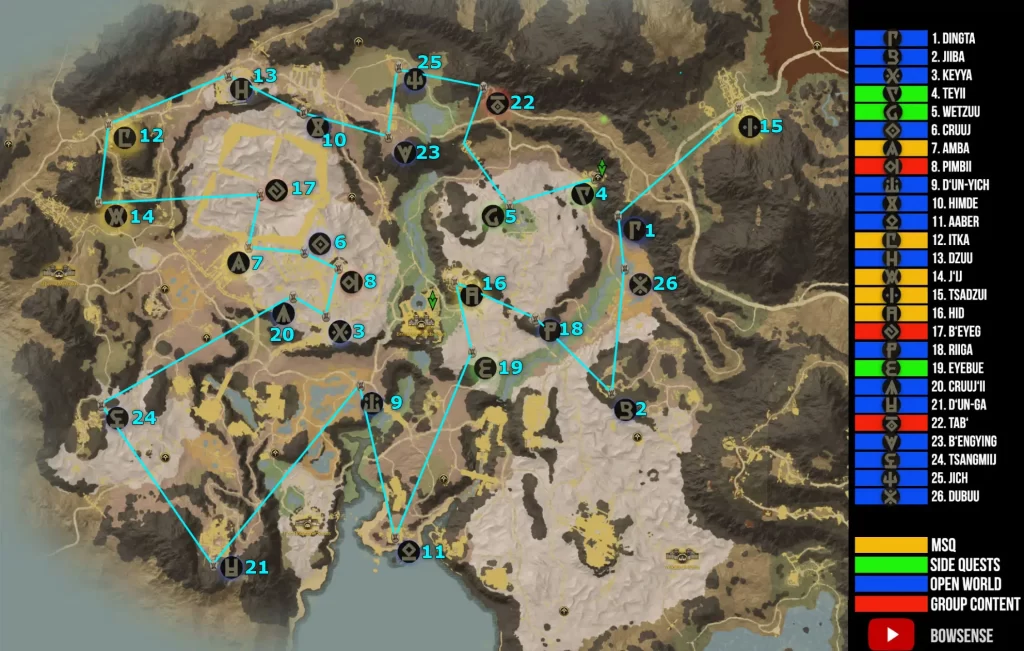
Player response strongly validated the approach. The Ancient Glyphs were widely cited as a meaningful shift in New World’s exploration design. They encouraged players to move laterally across content types rather than following a single linear path. Each glyph was hidden somewhere in Brimstone Sands and spanned multiple game modes. These included MSQ paths, open world exploration, Expeditions, and Elite Strongholds. Players documented their discoveries extensively and produced guides, videos, and community maps to track all 26.
The system’s success led directly to its evolution in later content. The design lineage continued in Elysian Wilds through the Signets of the Beast Lords, the Treasure Maps in Cutlass Keys, and later in Nighthaven via the Tarot Card system. All of these systems inherited the core idea of symbolic collection tied to mechanical unlocks.
The Ancient Glyphs originated from a single piece of early concept art created to define Ancient greebles for world art. Their visual distinctiveness and ubiquity across puzzles, devices, and environments made them impossible to ignore. Once their presence reached critical mass, the question shifted from what are these decorations to why do they exist. Brimstone Sands, home to one of Aeternum’s oldest Ancient civilizations, was the natural origin point for a true Ancient language.
Initially, the glyphs were scoped as simple Journal entries. Each unlocked a translated word of the Ancient language. That scope expanded rapidly once World Artists began constructing elaborate Ancient devices and mechanisms. As glyphs appeared on portals, chests, and machines, assigning unique interactions to each symbol became the obvious and necessary next step.
The Ancient Glyphs ultimately became more than a collectible system. They functioned as a unifying design layer. A language players could learn. A mystery they could solve. A set of mechanics that rewarded curiosity with tangible power.